Blogs
Discover the latest insights, guides, and updates on AI orchestration, real-time systems, and modern event-driven communication with DNotifier.
View Latest Blogs
This Series, Complete: 8 Providers, One API
Part ten of the DNotifier × Ollama series — closing the full eight-provider arc: OpenAI through Ollama, one sendAI() pattern, and deliberate per-step routing.

Securing a Reachable Ollama Endpoint
Part nine of the DNotifier × Ollama series — reachability versus security, reverse proxies, VPNs, and avoiding open inference on the public internet.
Ollama vs. DNotifier's Cloud Providers
Part eight of the DNotifier × Ollama series — eight providers through one sendAI() pattern, capability versus ops tradeoffs, and mixed workflows.
Keeping Your Local Models Fresh
Part seven of the DNotifier × Ollama series — no vendor retirement schedule, manual ollama pull cycles, and quarterly freshness checks.
Tool Calling on Local Models
Part six of the DNotifier × Ollama series — structured output and tool calling on Ollama, model-dependent reliability, and testing before production workflows.
When Local Beats Cloud (And When It Doesn't)
Part five of the DNotifier × Ollama series — air-gapped and data-boundary cases, cloud capability ceiling, and mixed local/cloud workflows per step.
Ollama Hardware: VRAM & Quantization
How much VRAM do you actually need to run Ollama locally? Real hardware tests covering quantization tradeoffs, CPU-only inference, and when self-hosting stops being worth it.
Choosing a Model to Run Locally
Part three of the DNotifier × Ollama series — parameter count, GGUF quantization, task-first selection, and Prompt Testing Studio on local models.
What Makes Ollama Different?
Part two of the DNotifier × Ollama series — no vendor bill, data that stays on your hardware, and what you give up versus cloud providers.
Ollama on DNotifier: Setup Guide
Part one of the DNotifier × Ollama series — configure a reachable base URL, pull models with ollama, and call local inference through provider ollama and sendAI().
Avoiding Lock-In: Azure and Beyond
Part ten of the DNotifier × Azure AI series — Foundry complexity, API retirements, deployment blast radius, and the seven-provider orchestration throughline.
Entra ID vs. API Keys on Azure
Part nine of the DNotifier × Azure AI series — static API keys versus Entra ID, RBAC, managed identities, and picking auth by organizational scale.
Foundry Agent Service vs. DNotifier
Part eight of the DNotifier × Azure AI series — Azure-native agents versus cross-provider Workflow orchestration, and when to use both.
Azure AI Content Safety vs. DNotifier
Part seven of the DNotifier × Azure AI series — harm filters, Prompt Shields, groundedness detection, and workflow-level controls that catch different failures.
Azure OpenAI Pricing: PAYG vs. PTU
Part six of the DNotifier × Azure AI series — pay-as-you-go tokens versus Provisioned Throughput Units, utilization math, and when each pricing shape fits.
Choosing a Deployment on Azure AI
Part five of the DNotifier × Azure AI series — model family versus deployment type, data residency, and Prompt Testing Studio before you commit traffic.
How Azure Retires AI Models
Part four of the DNotifier × Azure AI series — preview through retired lifecycle stages, notice periods, and Standard versus Provisioned retirement behavior.
Azure Retired Its Assistants API
Part three of the DNotifier × Azure AI series — the August 26, 2026 Assistants API retirement, Foundry Agent Service migration, and why DNotifier workflows were unaffected.
Azure AI Foundry vs. Azure OpenAI
Part two of the DNotifier × Azure AI series — Azure OpenAI Service versus Microsoft Foundry, consolidation versus replacement, and when each resource type fits.
Azure AI on DNotifier: Setup Guide
Part one of the DNotifier × Azure AI series — connect your Azure resource, match deployment names in sendAI(), and avoid the 404s that look like integration failures.
Avoiding Lock-In: Perplexity and Beyond
Part ten of the DNotifier × Perplexity series — Sonar retirement as a live lock-in lesson, task-based routing, and the six-provider series throughline.
Live Citations vs. Your Own RAG
Part nine of the DNotifier × Perplexity series — public web grounding versus private knowledge bases, hybrid workflows, and routing by source of truth.
Perplexity vs. DNotifier: Where It Fits
Part eight of the DNotifier × Perplexity series — answer engine versus multi-provider orchestration, Agent API overlap, and composing both in one workflow.
Perplexity's Search Filters, Explained
Part seven of the DNotifier × Perplexity series — domain allow/deny lists, recency and date filters, location, language, and scoping search for production.
Perplexity Pricing, Explained
Part six of the DNotifier × Perplexity series — tokens plus search-context fees, Deep Research billing, and estimating costs beyond headline per-token rates.
Choosing the Right Perplexity Model
Part five of the DNotifier × Perplexity series — Sonar tiers and Agent API presets, a three-question framework, and Prompt Testing Studio comparisons.
Perplexity's Agent API, Explained
Part four of the DNotifier × Perplexity series — managed runtime, built-in tools, max_steps, multi-model access, and when to adopt the API directly versus routing through DNotifier.
Perplexity's Sonar API Is Retiring
Part three of the DNotifier × Perplexity series — the September 27, 2026 Sonar sunset, Agent API presets, and how to avoid a hard production cutover.
What Makes Perplexity Different?
Part two of the DNotifier × Perplexity series — answer engines versus model vendors, parametric knowledge versus live grounding, and when citations are structural.
Perplexity on DNotifier: Setup Guide
Part one of the DNotifier × Perplexity series — connect Sonar search-grounded models, make cited live-web calls through sendAI(), and chain research and writing agents.
Avoiding Lock-In: Bedrock and Beyond
Part ten of the DNotifier × AWS Bedrock series — keep Bedrock as a strong default while routing specific tasks to other providers without an architectural rewrite.
Bedrock Knowledge Bases vs. DNotifier RAG
Part nine of the DNotifier × AWS Bedrock series — enterprise connectors versus unified runtime RAG, and picking retrieval per document set.
AgentCore vs. DNotifier
Part eight of the DNotifier × AWS Bedrock series — AWS-native agent infrastructure versus cloud-agnostic orchestration, and when to use each or both.
Bedrock Guardrails vs. DNotifier's Approach
Part seven of the DNotifier × AWS Bedrock series — model-call content safety versus workflow approvals, escalations, and why both layers matter.
AWS Bedrock Pricing, Explained
Part six of the DNotifier × AWS Bedrock series — on-demand vs provisioned vs batch, Knowledge Bases and Guardrails line items, and AgentCore billing.
Choosing a Model on Amazon Bedrock
Part five of the DNotifier × AWS Bedrock series — Nova, Claude, Llama, and Mistral on Bedrock, plus volume, latency, and Prompt Testing Studio comparisons.
Bedrock Agents Classic Is Being Retired
AWS is retiring Bedrock Agents Classic. Here's the exact maintenance-mode deadline, what breaks, and a straight migration path to AgentCore — or off Bedrock entirely.
Amazon Bedrock AgentCore, Explained
Part three of the DNotifier × AWS Bedrock series — Runtime, Memory, Gateway, Identity, and the other AgentCore services for production agents on AWS.
What Is AWS Bedrock?
Part two of the DNotifier × AWS Bedrock series — Bedrock as a managed access layer, model catalog, Guardrails, Knowledge Bases, and when AWS-native consolidation beats calling providers directly.
Bedrock on DNotifier: Setup Guide
Part one of the DNotifier × AWS Bedrock series — enable models in your AWS account, connect IAM or keys in the portal, and call Nova and other Bedrock models through sendAI().
Self-Hosting vs. DNotifier
Part ten of the DNotifier × Hugging Face series — the full cost of running your own inference stack versus hosted APIs and orchestration that stays the same either way.
Hugging Face for Regulated Industries
Part nine of the DNotifier × Hugging Face series — SOC 2, GDPR, Hub governance, paid-tier audit logs and BAAs, and separating model capability from compliance posture.
Hugging Face Spaces, Explained
Part eight of the DNotifier × Hugging Face series — Gradio and Streamlit demos for validation, what Spaces is good for, and why production traffic belongs elsewhere.
Picking an Open Model: A Guide
Part seven of the DNotifier × Hugging Face series — task-first filtering, size tradeoffs, licensing, quantization, and a shortlist-then-test workflow.
Building a Model-Router Agent
Part six of the DNotifier × Hugging Face series — classify request complexity and route to sized models with defineAgent, Workflow, and Inference Providers routing hints.
Smolagents vs. DNotifier
Part five of the DNotifier × Hugging Face series — code-as-action agents versus structured workflows, sandbox risk, and where each orchestration layer fits.
Inference Providers vs. Endpoints
Part four of the DNotifier × Hugging Face series — serverless multi-vendor routing versus dedicated Inference Endpoints, billing, cold starts, and when each fits.
Inside Hugging Face's Model Explosion
Part three of the DNotifier × Hugging Face series — what three million Hub models actually means, where the signal is, and how to filter noise into a shortlist.
Open Weights vs. Closed APIs, Explained
Part two of the DNotifier × Hugging Face series — open-weight models versus closed APIs, what actually changes technically and legally, and where each wins honestly.
Hugging Face on DNotifier: Setup Guide
Part one of the DNotifier × Hugging Face series — connect Inference Providers through one token, pick Hub models with routing hints, and mix open-weight models alongside closed APIs.
Gemini's Enterprise Platform, Explained
Part seven of the DNotifier × Gemini series — Vertex AI rebranded, HIPAA and VPC controls, Model Garden, and how enterprise compliance differs from app orchestration.
Flash, Pro, or Deep Think?
Part six of the DNotifier × Gemini series — when to use Flash, Pro, or Deep Think, how to tier models per agent, and the mistakes teams make in both directions.
Building a Multimodal Support Agent
Part five of the DNotifier × Gemini series — triage, resolution, and escalation agents in one workflow, with Gemini reading screenshots and text in a single call.
Google's ADK vs. DNotifier
Part four of the DNotifier × Gemini series — Agent Development Kit strengths, the Google-ecosystem bet, and where a model-agnostic orchestration layer fits.
Google Search Grounding, Explained
Part three of the DNotifier × Gemini series — how live Google Search grounding works inside Gemini calls, citations, billing, and when RAG is still the right tool.
Gemini's Multimodal Edge, Explained
Part two of the DNotifier × Gemini series — native multimodality versus bolted-on vision pipelines, where it actually matters, and where it doesn't.
Gemini on DNotifier: Setup Guide
Part one of the DNotifier × Gemini series — connect Google Gemini through sendAI(), pick Flash vs Pro, and use session memory, RAG, and observability without a provider-specific rewrite.
Long Context, Better Agent Memory
Part five of the DNotifier × Claude series — why a 1M-token window doesn't replace session memory or RAG, and how Anthropic's own compaction feature proves the point.
Building Research Agents with Claude
Part four of the DNotifier × Claude series — a three-agent research pipeline (Sonnet, Opus, Fable) with shared workflow state and explicit fact-checking, built with defineAgent and Workflow.
Claude's Managed Agents vs. DNotifier
Part three of the DNotifier × Claude series — Anthropic's Managed Agents platform is serious infrastructure. Here's the honest tradeoff versus a model-agnostic control plane.
DNotifier's MCP Support, Explained
Part two of the DNotifier × Claude series — what the Model Context Protocol is, why adoption exploded in 2026, and how DNotifier connects MCP servers to your agents without per-call wiring.
Claude on DNotifier: Setup Guide
Part one of the DNotifier × Claude series — connect Anthropic through sendAI(), pick the right Claude model tier, and get session memory, RAG, and observability without building the plumbing yourself.
Building a Production Multi-Agent Customer Support System with OpenAI and DNotifier
Part three of our OpenAI series: three specialized agents, shared workflow state, cost-tiered models, and a human approval gate — built with defineAgent and Workflow, not pseudocode.
OpenAI's Agents API vs. DNotifier: A Managed Harness or a Model-Agnostic Control Plane?
OpenAI's September 2026 Agents API is a serious option for OpenAI-only teams. This post lays out the real tradeoffs versus a model-agnostic control plane like DNotifier — without the spin.
Building AI Agents on OpenAI with DNotifier: A Practical Integration Guide
Part of a series on AI workflows across model providers — connect OpenAI through one sendAI() integration, with session memory, RAG, prompt testing, and observability handled for you.
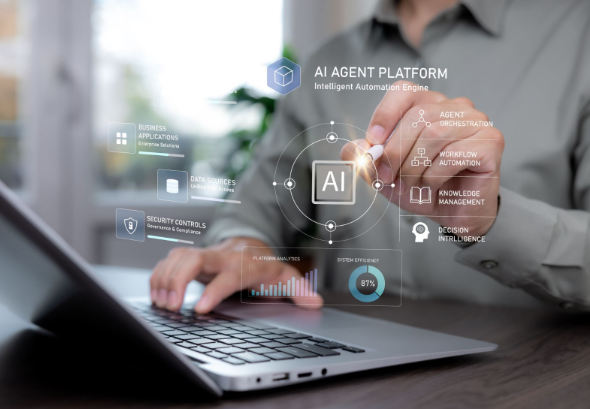
Scalable Architecture For AI Agents
Agent demos break when usage grows because state, memory, and coordination don't scale like stateless APIs. Learn what scalable architecture for AI agents includes—routing, workers, event-driven design, and observability.
AI Agent Scalability: What It Actually Takes
When real users arrive, agents slow down or break—not because of the model, but queues, concurrency, and coordination. Learn what AI agent scalability means and how to scale workers, messaging, and observability before load exposes the gaps.
Build AI Agent Infrastructure: A Practical Guide
When real traffic hits, demos break without orchestration, memory, monitoring, and messaging. A practical order for building AI agent infrastructure—and when a unified platform beats stitching tools together.
What Production AI Infrastructure Actually Takes
Demos break when real users arrive: lost context, hung tool calls, and silent wrong answers. Learn what production AI infrastructure covers—memory, messaging, monitoring, and cost predictability—and how to ship agents that hold up at scale.
How to Build AI Agent Infrastructure With DNotifier
One agent works until you add memory, a second agent, or production monitoring. Learn what AI agent infrastructure actually includes and how DNotifier delivers orchestration, events, search, and traceability in one SDK.
What Is an AI Agent Control Plane?
Agent code plans steps; the control plane enforces security, logs traces, and validates permissions. Learn what an AI agent control plane is, why teams need one, and how DNotifier delivers it.
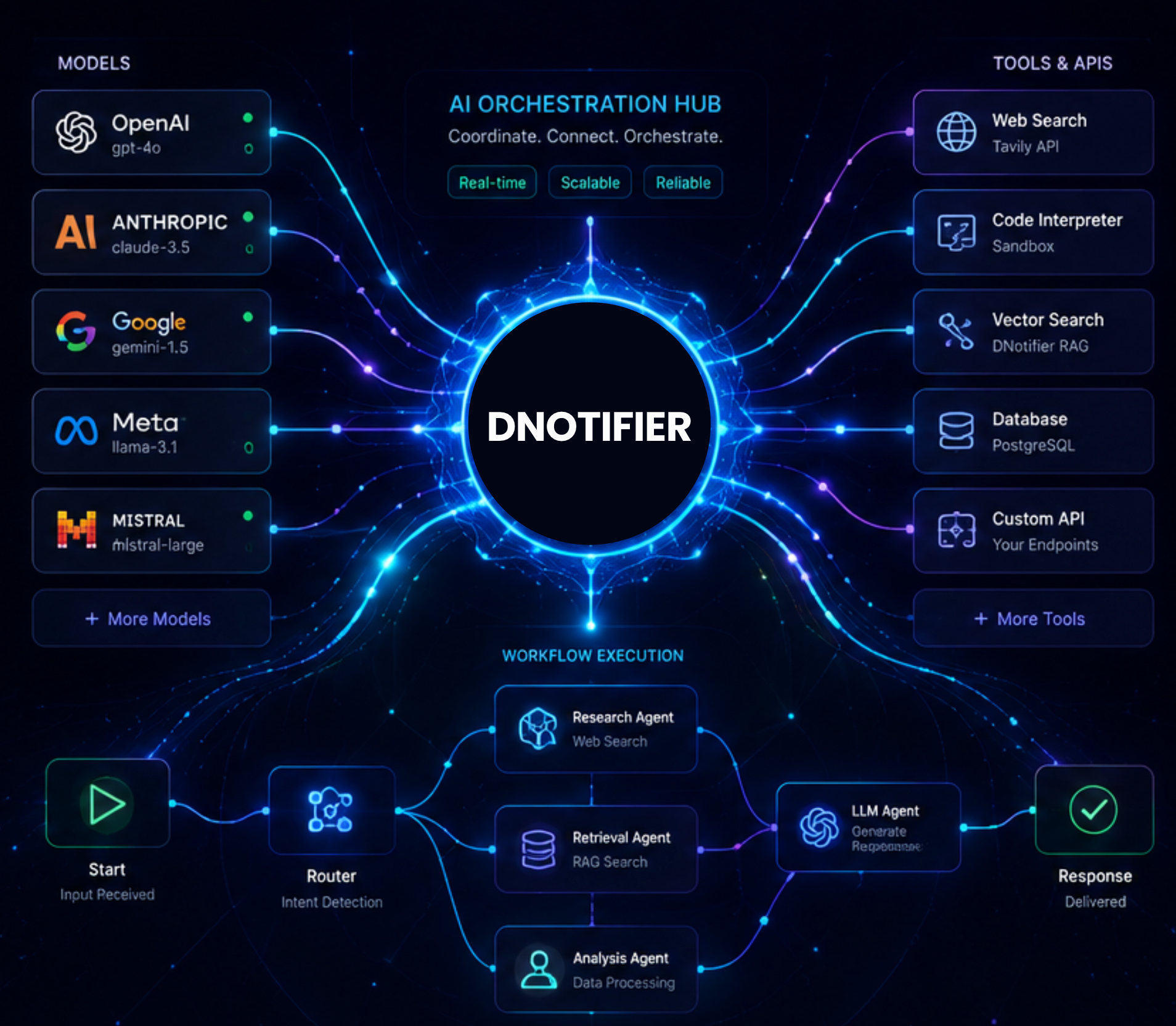
AI Agent Infrastructure Architecture: A Practical Breakdown
Demo agents break when real users arrive. Learn the core components, architecture patterns, orchestration, and backend design that keep AI agent infrastructure reliable at scale.
What Is AI Agent Infrastructure? | DNotifier
Demo agents break in production when the plumbing isn't there. Learn what AI agent infrastructure actually means, the core layers you need, and why most teams skip them until it's too late.
How to Build Enterprise Systems with an AI Agent Workflow Platform
Local scripts break in production when agents hang, loop, or lose context. Learn how an enterprise AI agent workflow platform handles state, observability, multi-agent routing, and RAG with DNotifier.
AI Agent SDK: Build Agents That Actually Work
The model call takes ten minutes. Memory, tool calls, and multi-agent coordination take weeks. Learn what an AI agent SDK actually handles and how DNotifier keeps you from gluing five libraries together.
What an AI Agent Dev Platform Actually Does | DNotifier
Demo agents are easy. Adding memory, a second agent, and production monitoring is where things fall apart. Learn what an AI agent development platform actually handles—and why it matters once you ship.
Building AI Agents That Survive Production
Notebook demos break fast in production. Learn what an AI agent platform and runtime actually do, why most architectures fail under real traffic, and how DNotifier handles orchestration, memory, and observability.
AI Agent Frameworks: Built for the Real World
Building a simple AI agent looks easy until you link two together or need context across sessions. Learn what agent frameworks actually do, why most break in production, and how DNotifier keeps multi-agent workflows stable.
AI Agent Infrastructure vs Framework | DNotifier
Frameworks give agents a brain; infrastructure keeps them alive in production. Learn the real difference between AI agent infrastructure and AI agent frameworks, and why teams confuse them at their peril.
Multi-Agent Orchestration Patterns and Best Practices
Three agents running at once and stepping on each other isn't a bug — it's a missing orchestration pattern. Learn sequential, parallel, hierarchical, and event-driven patterns and when to use each.
Multi-Agent Systems in the AI World
Single models buckle under complex tasks. Learn why the AI world is shifting to specialized agent teams, how they communicate, and what orchestration and observability take to get right.
How to Build Multi-Agent Systems
You add a second AI agent and coordination breaks down fast. Learn how to design orchestration, routing, traceability, and real-time communication before scaling your multi-agent AI system.
DNotifier: Layered AI Infrastructure Platform
If you are an architect, developer, or enterprise building AI at scale, DNotifier provides production-ready infrastructure for agent orchestration, multi-agent collaboration, LLM streaming, and enterprise AI — all in a single unified SDK.
Our AI Agents Are Starting to Look Like Software Teams Now
Modern AI systems are evolving from single-purpose bots into coordinated teams of agents. This post explains how DNotifier’s distributed messaging makes it possible to treat AI agents like software teams that collaborate, share knowledge, and act on real product data.
The Real Problem With AI Apps Isn't the Model | DNotifier
Most teams focus on choosing the right AI model, but the real difficulty is building the messaging, agent coordination, memory, chat, and data access infrastructure around it. This post explains why DNotifier’s distributed messaging layer is the missing foundation for real AI products.
No More LangGraph: Build Your Own Agentic Graph
LangGraph gave structure to multi-agent chaos. But once you start building real systems, you hit a wall — the graph isn't the problem, the communication is. Here's how DNotifier lets you build a living, distributed agentic graph without predefined flow.
Agentic Development via DNotifier
We thought we were building modern distributed systems — but things weren't reacting together the way we expected. The real bottleneck wasn't compute, it was communication. Here's how DNotifier changed the way we think about architecture.
Multiple Agents Communicating via DNotifier
The future of distributed, real-time systems is here. Discover how DNotifier acts as a real-time interaction fabric between distributed agents — from AI models to IoT devices — enabling any node to talk to any other node instantly.
Best Real-Time Messaging APIs in 2026 (Comparison Guide)
Compare real-time messaging solutions including PubNub, DNotifier, Ably, Pusher, and Socket.IO. Discover when to choose centralized architectures.
Scalable Microservices Architectures
If you're comparing options against other available old solutions, discover how DNotifier works well for rapid development and scaling long-term with architectural flexibility.