How to Build AI Agent Infrastructure With DNotifier

You've got a working agent. It calls a model, gets an answer, and moves on. Then you try to add a second agent, or hook up memory, or track what went wrong at 2 a.m., and the whole thing falls apart.
That's the real challenge behind trying to build AI agent infrastructure. Not the agent logic itself. Everything holding it together: orchestration, events, memory, and visibility into what's actually happening. Most teams only notice the gap once they're already stuck in it, usually right after launch.
DNotifier was built to close that gap. One SDK. One API. Everything an agent stack needs, without stitching together five separate tools.
What Is AI Agent Infrastructure?
AI agent infrastructure is the backend layer that lets agents run reliably. It handles orchestration, communication between agents, memory, and monitoring. Without it, an agent is just a single API call with no way to scale, coordinate, or recover from failure.
Why Teams Struggle to Build an AI Agent Platform
Most teams start with one agent and one prompt. It works fine, until it doesn't.
The moment you try to build an AI agent platform that supports multiple agents and real production traffic, the gaps show up fast. You need a way to route messages, test prompts before they ship, and catch failures before users do.
Bolting these pieces together yourself means managing separate logins, separate docs, and separate failure points. One update breaks another tool, and you spend more time on plumbing than on the actual agents. That's time you're not spending on the product itself.
DNotifier handles all of this through one connected system instead of a pile of disconnected tools.
Core AI Infrastructure Components You Actually Need
Every reliable agent setup needs a few non-negotiable pieces. Skip one, and something breaks later, usually in production, usually at the worst time.
Here's the short list of AI infrastructure components that matter most:
That's your AI agent infrastructure stack in five pieces. DNotifier ships all five natively, so you're not gluing together separate vendors for each one and hoping they stay compatible after the next update.
Agent Platform Architecture: How DNotifier Connects the Pieces

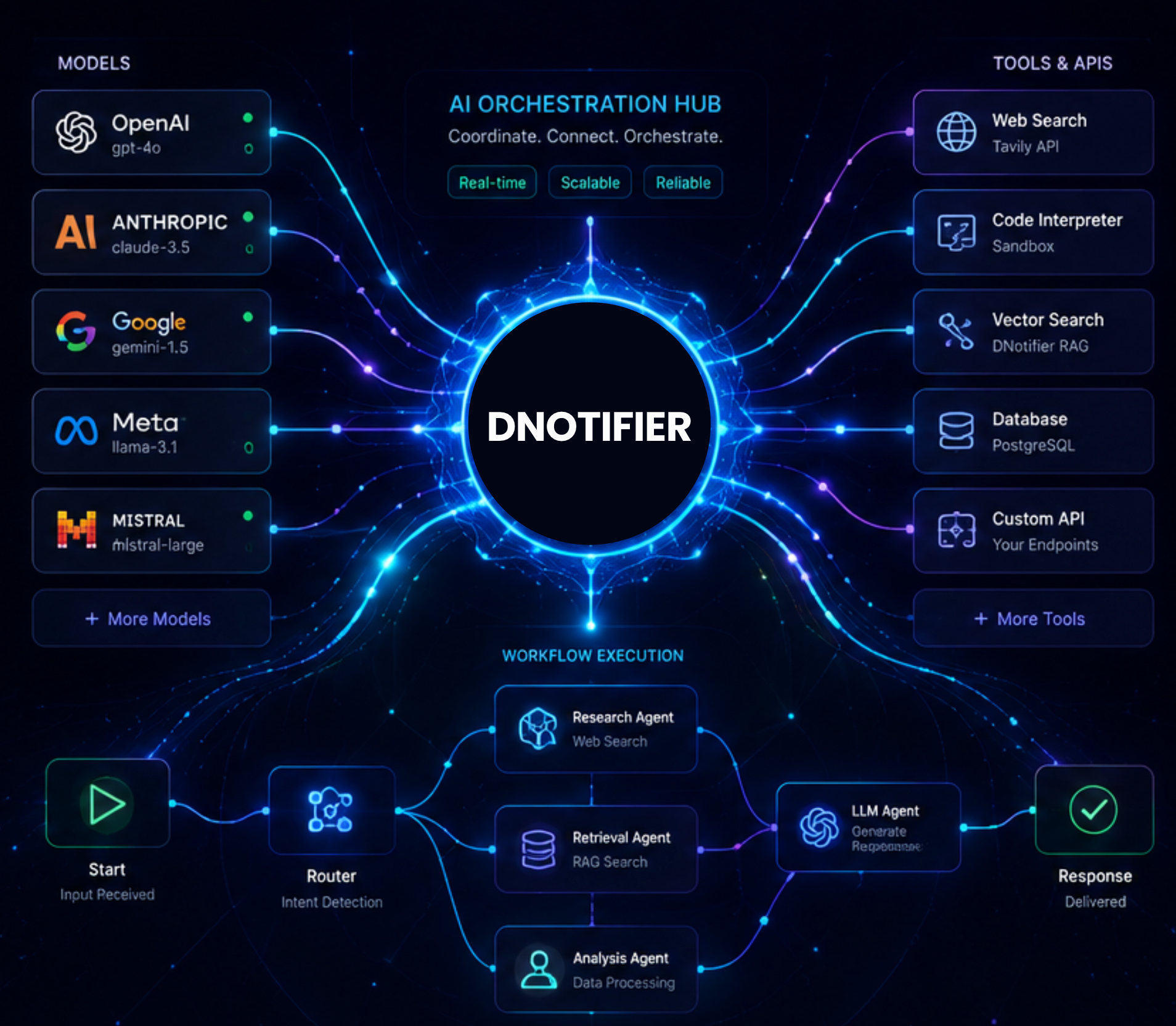
The diagram above shows the DNotifier agent platform architecture as two connected layers.
The first layer runs your agents. AI Orchestration sequences tasks and decides what happens next. Real-Time Pub/Sub and Chat Systems move information between agents the moment it's ready, not on a delay.
The second layer keeps you informed. Semantic Search gives agents accurate context from your own data. Monitoring, Observability, and Traceability show you what each agent did, and why it did it.
DNotifier runs as one centralized system. These layers share the same SDK and API, so your agents don't need custom code to bridge one tool to another. Add a new agent, and it inherits the same orchestration, events, and monitoring as every other agent already running. You don't rebuild the wiring each time your system grows.
Event-Driven Agent Infrastructure: Why It Matters
Polling for updates is slow and wastes resources. Event-driven agent infrastructure flips that around. Agents react the instant something changes, instead of checking on a timer.
DNotifier's Real-Time Pub/Sub layer pushes events to agents as they happen. One agent finishes a task, and the next one starts right away. No delay, no wasted calls, no manual triggers.
This matters most in multi-agent systems, where one agent's output often becomes another agent's input. A slow handoff between two agents can stall an entire workflow, especially when several agents depend on the same result.
Building Your AI Agent Backend Infrastructure Step by Step
Here's a simple AI agent infrastructure tutorial to get your first setup running.
Start by mapping your workflow in AI Workflows. Decide which agent handles which task, and in what order they run.
Next, connect your agents through the SDK. This gives them access to orchestration, pub/sub, and search without any extra setup on your end.
Then test your prompts. Prompt Testing lets you check output quality before it reaches real users, so you catch problems early instead of after launch.
Finally, turn on Monitoring and Traceability. You'll see every request, every response, and every failure as it happens, not after a user reports it.
That's the backbone of a solid agent orchestration backend, built on one platform instead of five.
FAQ
What's the difference between an agent and agent infrastructure?
An agent is a single unit that completes one task. Infrastructure is everything that helps multiple agents run, communicate, and recover from failure together, especially as the system grows.
Do small projects need event-driven infrastructure?
Not always. A single-agent project can run fine without it. Once you add multiple agents or real-time needs, event-driven infrastructure becomes worth setting up early rather than later.
Can DNotifier handle both orchestration and monitoring?
Yes. DNotifier bundles orchestration, pub/sub, semantic search, and monitoring inside one SDK and API. You don't need separate tools for each piece, or separate bills to manage.
Is DNotifier built for small teams or only large systems?
Both. Small teams use it to skip early infrastructure headaches. Larger teams use it to keep growing agent systems from turning into a tangled mess of services.
Final Thought
Agents are easy to build. Infrastructure is what makes them last. When you build AI agent infrastructure on one connected platform, orchestration, memory, and monitoring stop being separate headaches and just work together.
Explore the SDK at dnotifier.com and see how fast you can get your first agent stack running.
Related articles
AI Agent Infrastructure Architecture: A Practical Breakdown
Demo agents break when real users arrive. Learn the core components, architecture patterns, orchestration, and backend design that keep AI agent infrastructure reliable at scale.
Build AI Agent Infrastructure: A Practical Guide
When real traffic hits, demos break without orchestration, memory, monitoring, and messaging. A practical order for building AI agent infrastructure—and when a unified platform beats stitching tools together.
AI Agent Scalability: What It Actually Takes
When real users arrive, agents slow down or break—not because of the model, but queues, concurrency, and coordination. Learn what AI agent scalability means and how to scale workers, messaging, and observability before load exposes the gaps.