How to Build Multi-Agent Systems

You add a second AI agent to your stack, and suddenly nothing talks to anything else properly. Agents duplicate work. Nobody knows which one made which call. This is the exact moment where building multi-agent systems the right way starts to matter.
Get the foundation right early, and scaling gets easier. Get it wrong, and every new agent adds more chaos than value.
What Is a Multi-Agent System in AI?
A multi-agent system in AI is a setup where multiple AI agents work together toward a shared goal. Each agent handles a specific task, then hands off to the next one. Instead of one model doing everything, you get specialized agents coordinating in sequence.
Done well, this beats a single monolithic AI agent trying to do it all.
Why You Need an AI Infrastructure Platform Before You Scale
You need an AI infrastructure platform before scaling because manual coordination breaks down fast. Two agents are easy to manage by hand. Five or more, talking to different models, is not something you want to wire together yourself.
An infrastructure platform gives you routing, monitoring, and coordination in one place. Without it, teams end up duct-taping custom scripts between every agent pair. That gets fragile fast, and it gets worse with every agent you add.
Step 1: Design Your AI Orchestration Layer First
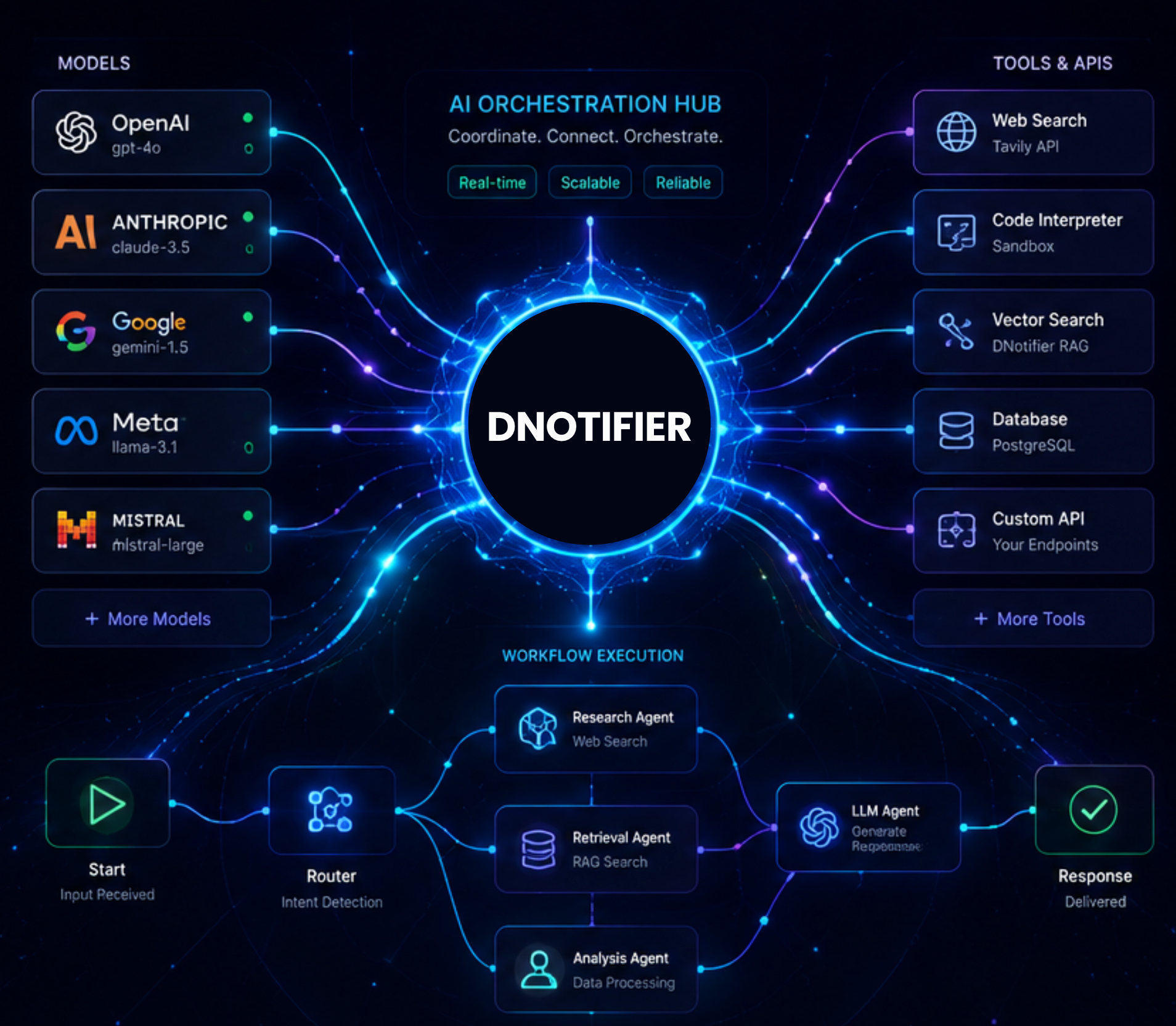
Before writing a single agent, decide how they'll talk to each other. This is your AI orchestration layer, and it's the backbone of the whole system.
DNotifier's AI Orchestration tools let you define these handoffs once. You set the rules for how tasks move between agents. No more hardcoding logic into every individual service.
Get this right early, and every agent you add later plugs into an existing structure. Skip it, and you're rebuilding coordination logic every time you scale.
Step 2: Set Up AI Routing Between Agents and Models
Not every task needs your most expensive model. Smart AI routing sends each task to the right model based on cost, speed, or complexity.
This matters more once you're running a multi agent AI system with several models in play. Route simple tasks to lighter models. Save your heavier models for the tasks that actually need them. This alone can cut costs significantly as your agent count grows.
Step 3: Build In Workflow Testing and Prompt Testing
Agents run on prompts, and prompts drift over time. What worked last month might quietly stop working today.
DNotifier's Prompt Testing tools let you validate changes before they hit production. Pair this with proper AI workflow automation testing, and you catch broken handoffs before users ever see them. Skipping this step is one of the most common reasons multi-agent systems fail in production.
Step 4: Add AI Traceability From Day One
When an agent makes a wrong call, you need to know why immediately. Not after digging through five different logs for an hour.
AI traceability gives you the full path behind every decision. Which agent acted, which prompt fired, which model responded. DNotifier's Traceability tools capture this automatically, so debugging becomes fast instead of painful.
Step 5: Use a Centralized Event Mesh for Real-Time Communication
Agents need to know what other agents are doing, in real time. Polling constantly for updates wastes resources and slows everything down.
A centralized event mesh designed for SMEs solves this cleanly. DNotifier's Real-Time Pub/Sub layer lets agents publish and receive updates instantly. Everyone stays in sync without constant checking, and that keeps your highly centralized AI agents actually coordinated instead of guessing.
Step 6: Layer In Semantic Search
Your agents aren't just talking to each other. They're often pulling information from your own data too.
Semantic search lets agents find relevant context without relying on rigid keyword matching. DNotifier's Semantic Search tooling makes this straightforward to add. This becomes essential once your agents answer questions based on internal docs or historical records.
Common Mistakes When Building Multi-Agent Systems
A few mistakes show up again and again.
Skipping orchestration planning. Teams start coding agents before deciding how they'll coordinate. This leads to messy, one-off integrations that don't scale.
Ignoring traceability early on. By the time something breaks, the data you need to debug it is already gone.
Treating every agent as equally important. Not every task needs your most powerful model. Smart routing saves real money over time.
FAQ
What's the difference between a single AI agent and a multi-agent system?
A single agent handles a task end to end. A multi-agent system splits the work across specialized agents that coordinate with each other.
How many agents do I need before I need proper orchestration?
Two or three agents can be managed manually. Beyond that, you need real orchestration to avoid coordination chaos.
Does building multi-agent systems always mean using multiple different models?
No, but it often helps. Different tasks suit different models, and smart routing lets you use each one where it fits best.
Can I add multi-agent coordination to an existing single-agent setup?
Yes, most teams start with one agent and expand from there. The key is building your orchestration layer before you add the second one.
The Bottom Line
Building multi-agent systems isn't about adding more agents. It's about making sure they actually work together.
If you're planning your next multi-agent AI system, check out [www.dnotifier.com](https://www.dnotifier.com/) and see how the SDK handles orchestration, routing, and coordination in one place.
Related articles
Multi-Agent Orchestration Patterns and Best Practices
Three agents running at once and stepping on each other isn't a bug — it's a missing orchestration pattern. Learn sequential, parallel, hierarchical, and event-driven patterns and when to use each.

How to Build AI Agent Infrastructure With DNotifier
One agent works until you add memory, a second agent, or production monitoring. Learn what AI agent infrastructure actually includes and how DNotifier delivers orchestration, events, search, and traceability in one SDK.
AI Agent Infrastructure Architecture: A Practical Breakdown
Demo agents break when real users arrive. Learn the core components, architecture patterns, orchestration, and backend design that keep AI agent infrastructure reliable at scale.