Multi-Agent Orchestration Patterns and Best Practices

You built a multi-agent system, and it works, until three agents try to run at the same time and step all over each other. That's not a bug. That's a missing orchestration pattern.
Picking the right multi-agent orchestration pattern early saves you from rebuilding your coordination logic later. Here's how the main patterns work, and when to use each one.
What Are Multi-Agent Orchestration Patterns?
Multi-agent orchestration patterns are structured ways to coordinate how agents run, communicate, and hand off tasks. Each pattern controls the order and flow of work between agents. Picking the wrong one usually shows up as bottlenecks, duplicate work, or agents waiting on each other unnecessarily.
Most systems fit into one of four common patterns, sometimes a mix of two.
Pattern 1: Sequential Orchestration
Sequential orchestration runs agents one after another, in a fixed order. Agent A finishes, then Agent B starts, then Agent C. This is the simplest pattern to build and debug.
This works well when each step genuinely depends on the last one's output. A research agent gathers information, then a writing agent drafts content based on that research. Trying to run these in parallel wouldn't make sense since one needs the other's result first.
The downside is speed. If Agent A takes ten seconds, your whole pipeline waits ten seconds before anything else happens.
Pattern 2: Parallel Orchestration
Parallel orchestration runs multiple agents at the same time, then merges their outputs. This works well when tasks don't depend on each other.
Picture three agents each analyzing a different data source at once, then a fourth agent combining their findings. This cuts total run time significantly compared to running each agent one by one.
The tradeoff is coordination complexity. You need clear rules for how outputs get merged, and what happens if one agent finishes late or fails entirely.
Pattern 3: Hierarchical Orchestration
Hierarchical orchestration uses a supervisor agent to manage worker agents beneath it. The supervisor assigns tasks, checks results, and decides what happens next.
This pattern scales well for a highly centralized AI agent setup, where one controller needs oversight across many specialized agents. The supervisor can retry failed tasks, reassign work, or escalate issues without touching every worker agent's internal logic.
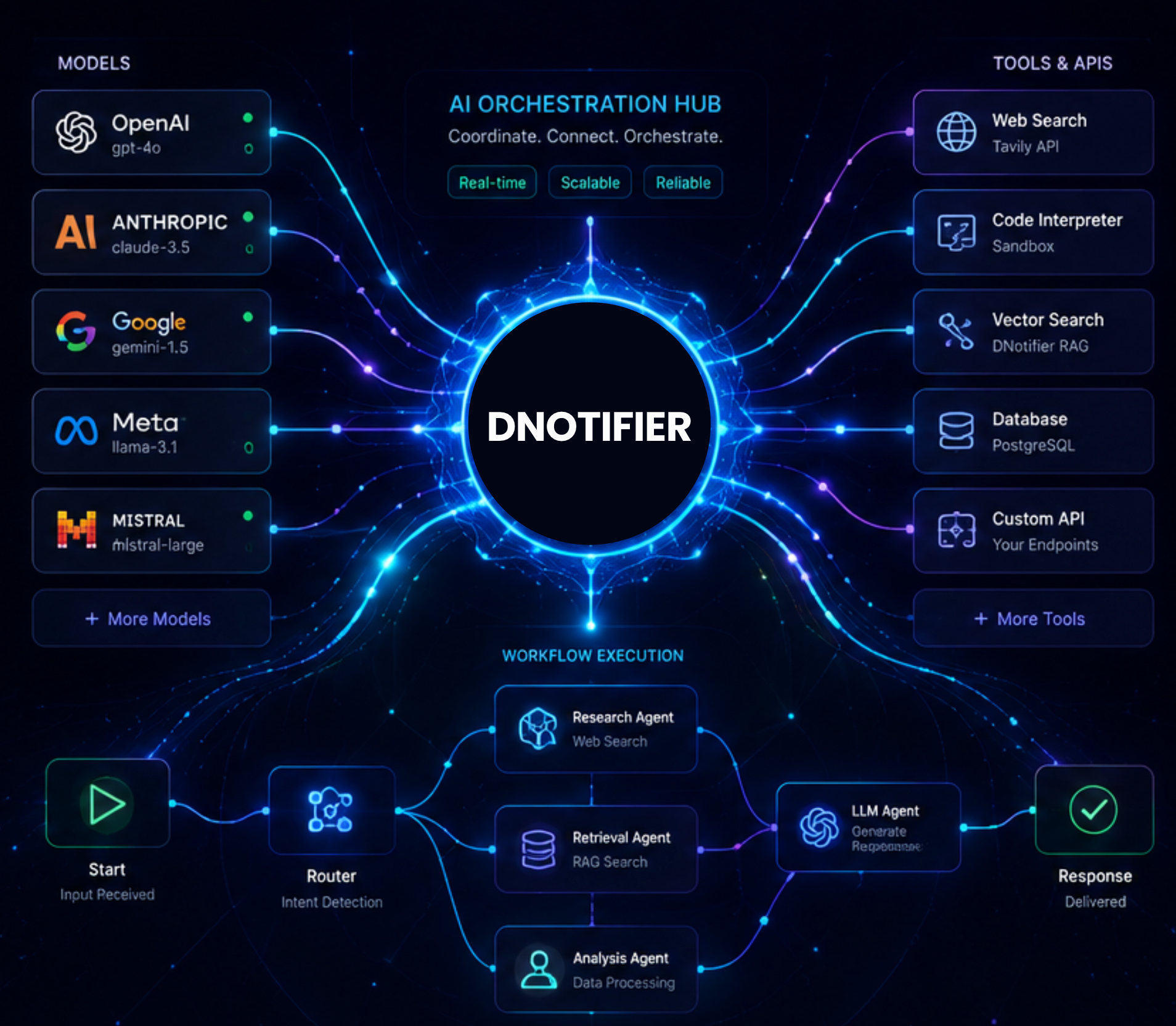
DNotifier's AI Orchestration tools support this pattern directly. You define the supervisor's rules once, and it manages routing across your entire multi agent AI system from there.
Pattern 4: Event-Driven Orchestration
Event-driven orchestration triggers agents based on events, not a fixed schedule or sequence. An agent finishes a task, fires an event, and whichever agent is listening picks it up.
This pattern fits systems that need real time communication and fast reactions to changing conditions. Nobody's polling for updates every few seconds, which wastes resources and adds unnecessary lag.
A centralized event mesh designed for SMEs makes this pattern practical without heavy infrastructure work. DNotifier's Real-Time Pub/Sub layer handles this natively, so agents publish and subscribe to events without you building a custom messaging system from scratch.
Best Practice: Build AI Routing Into Every Pattern
Regardless of which pattern you pick, smart AI routing matters. Not every task needs your most expensive model.
Route simple classification tasks to lighter, cheaper models. Save your most capable models for tasks that genuinely need the extra reasoning. This applies across sequential, parallel, and hierarchical setups alike, and it can meaningfully reduce your model costs as usage grows.
Best Practice: Test Workflows Before They Break in Production
Orchestration logic looks fine on paper until real inputs hit it. Edge cases break handoffs in ways you won't predict ahead of time.
Workflow testing catches these problems before users do. Pair this with prompt testing for each individual agent, and you're validating both the parts and the whole system together. DNotifier's Prompt Testing tools make this part of your regular AI workflow automation, not an afterthought before launch.
Best Practice: Prioritize Traceability From the Start
When something breaks in a multi-agent pipeline, you need to know exactly where. Not after tracing through five separate log files by hand.
AI traceability captures the full path behind every decision. Which agent acted, what input it received, what it passed along next. DNotifier's Traceability tools build this in automatically, so debugging a failed handoff takes minutes instead of hours.
Best Practice: Add Semantic Search for Context-Heavy Tasks
Agents often need more than what's in the immediate prompt. They need relevant context pulled from your actual data.
Semantic search handles this without relying on brittle keyword matching. DNotifier's Semantic Search tooling plugs into any of these orchestration patterns, giving agents the context they need without extra custom retrieval logic.
Choosing the Right Pattern for Your System
Most real systems don't use just one pattern. A hierarchical supervisor might manage a sequence of sub-agents, some of which run in parallel.
Start simple. Use sequential orchestration for straightforward, dependent tasks. Add parallel or event-driven patterns as your AI infrastructure platform needs to handle more concurrent work.
FAQ
Which orchestration pattern is easiest to start with?
Sequential orchestration is the simplest to build and debug. Start here if your agents depend on each other's outputs.
Can I combine multiple orchestration patterns in one system?
Yes, most production systems mix patterns. A hierarchical supervisor often manages agents running in parallel or sequential sub-flows.
Why does event-driven orchestration matter for real-time systems?
It removes the lag from constant polling. Agents react to events immediately instead of waiting for a scheduled check.
How do I know which pattern fits my use case?
Look at task dependencies first. If tasks depend on each other, go sequential. If they don't, parallel or event-driven usually fits better.
The Bottom Line
The right orchestration pattern turns a chaotic pile of agents into a system that actually scales. Pick based on your task dependencies, not just what's easiest to build first.
If you're mapping out orchestration for your own multi-agent setup, check out [www.dnotifier.com](https://www.dnotifier.com/) and see how routing, traceability, and real-time coordination work together in one SDK.
Related articles
How to Build Multi-Agent Systems
You add a second AI agent and coordination breaks down fast. Learn how to design orchestration, routing, traceability, and real-time communication before scaling your multi-agent AI system.

How to Build AI Agent Infrastructure With DNotifier
One agent works until you add memory, a second agent, or production monitoring. Learn what AI agent infrastructure actually includes and how DNotifier delivers orchestration, events, search, and traceability in one SDK.
AI Agent Infrastructure Architecture: A Practical Breakdown
Demo agents break when real users arrive. Learn the core components, architecture patterns, orchestration, and backend design that keep AI agent infrastructure reliable at scale.